Posts

Jan Gordon and Pablo Picasso
Image
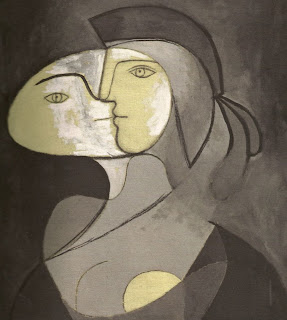
Last weekend we visited the Picasso Black and White exhibition at the Museum of Fine Arts Houston . The range of styles on show was remarkable, from coolly classical to astonishingly abstract. "Head of a Man" 1908 looks like a Fang Ngil mask from Gabon. The several studies for “Guernica” reminded me of a visit to that town in 1994 (studying the nearby geology), looking quiet and peaceful on a sunny day and giving no hint of the Luftwaffe's horrific bombing in 1937 . Jan and Cora Gordon were contemporaries of Picasso in Paris and Jan Gordon wrote about him in “ Modern French Painters ” (1923 and later editions), a volume dedicated to my grandparents . He wrote, “Picasso – Pablo Ruiz is his real name – is the most vivid and and the most dramatic personality which has come into the art of today.” “Picasso may well be considered as the problem of modern art. He has bewildered the public by the variety of and the differences between his artistic p...

Jan and Cora Gordon and "Many-sidedness"

Image
I was thinking today about what an interesting couple Jan and Cora Gordon were. From their marriage in 1909 to Jan’s death in 1944 the output of paintings, drawings, etchings, books, magazine articles and concerts seems remarkable. For a way in to their world of travels, art and music visit these pages: Art of Jan and Cora Gordon . I like this comment from one of Jan Gordon’s obituaries : “Mr Gordon's many-sidedness had a touch of the Italian Renaissance.” I also like Jack Bilbo’s comment in the October 1944 issue of The Studio magazine: “I remember when he and Cora used to sit in my den on Saturday afternoons when the gallery was closed, when we exchanged travel experiences from Spain and Yugoslavia, from Mexico and Scandinavia, or talked about artists and paintings, how the four walls of my little room seemed to move away into far distances.” I know some highly multifaceted, well-travelled and creative personalities today, but can’t think of anyone qui...

Jan Gordon: A Step-ladder to Painting

Image
Jan and Cora Gordon wrote many books on their travel experiences between 1915 and 1933 and Jan wrote a number of novels and also books on art (an overview can be found in Jan and Cora Gordon Books ). I have read one of these books, " A Step-ladder to Painting ", several times (though not for many years), with the idea of learning something about composition (which would also come in handy for photography). I remember being particularly interested in the discussion of the importance of memory. For example (pg 225), " .. during our trip to Spain all our sketch books and notes were stolen on the railway. Yet we were able to reconstruct Poor Folk in Spain with text and drawings almost entirely from memory, and the book was accepted as accurate even by Spanish critics. " Their memories were not quite as accurate as claimed though and they remembered D. Antonio Gimenez, the Vera guitar-maker, as Don Gomez Fuentes. One of the things I most like about my batter...

Westgarth Forster 1821: "Cauk, or barytic, spar"

Image
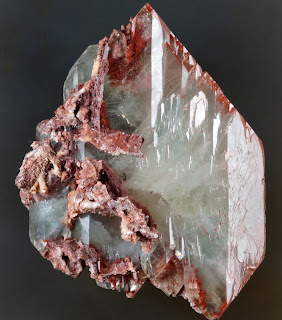
One of the treasured crystallized minerals from the mines of Northern England is the barium sulphate barite (or baryte). Beautiful doubly-terminated 6 cm blue barite from Frizington, Cumbria, with red areas resulting from hematite inclusions. Westgarth Forster (1821, pages 216-217), makes the following comments on this mineral: “ Cauk , or barytic , spar, is not generally of so pure a white as the calcareous spars. The writer of this has seen cauk spar of a dead white, but commonly it is of a yellowish, a brownish, or a reddish white, or of a flesh colour, sometimes crystallized and transparent, as at Dufton-fell , in the county of Westmorland. It seems to affect the peculiarity of having its crystals laminated, as radiating from a centre, but this radiation seldom amounts to a whole circle. It is commonly a dull ill-looking spar, frequently rising in in globes and irregular masses, and so exceedingly heavy, that miners have always imagined it contained metal...

Westgarth Forster, 1821: "Fluor spar occurs in veins in a great many different colours"

Image
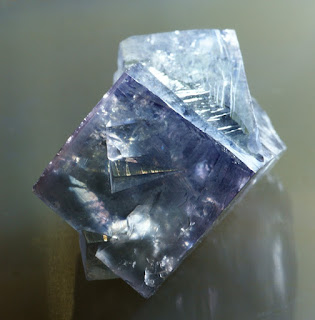
Reading through  Westgarth Forster's 1821, “A Treatise on a Section of the Strata from Newcastle to Cross Fell”, I came across the following (on page 218): “Most of the mineral spars are frequently found shot into prismatic, cubic, hexagonal, or other figures. These figured crystals are generally transparent, and very beautiful. It is a great curiosity to behold the inside of some of the large cavities in which they are formed. These caverns, lined with crystals, are frequently met with in hard mineral veins; and they are generally called, by miners, shakes , lochs , or loch-holes .” On page 216 he writes the following about one of these mineral spars (today known as fluorite): “Fluor spar occurs in veins in a great many different colours, viz. white, green, violet, yellow, red, and brown. Its most general form, when crystallized, is a cube, but it is frequently met with in the form of an octahedron and cubo octahedron, it also occurs in amorphous shapeles...