Posts

Lobtailing, Spyhopping and Breaching in Gabon

Image
The sad story this week of a stranded humpback whale in Port Gentil, Gabon reminded me of encounters with these whales in the Baie du Cap Lopez (I wrote the following short account in 1997). Humpback whales are regular dry season visitors to the coastal waters of Gabon. They are the most acrobatic of whales and have been said to have the most complex vocalisations of any animals after ourselves. In 1987, after an oceanography conference in Woods Hole, I went looking for Humpbacks off Cape Cod. Their scientific name, Megaptera novaeangliae (big-winged New Englander) refers to their giant pectoral fins and common occurrence offshore Massachusetts and Maine. So, It was the right place to be looking. That trip was no disappointment, with several Northern Right Whales and a pair of Fin Whales (the second largest creatures on the planet, over 20m long) putting in appearances. Not a single Humpback showed, however. 13/7/97. Baie du Cap Lopez. This is why they’re called ...
Forest Elephants of Gabon

Image
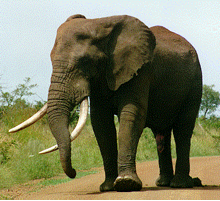
I was saddened to read about the 26 forest elephants recently slaughtered at the Dzanga Bai in the Central African Republic. My affection for forest elephants dates to a spell of five years living in Gabon in the 1990s and I wrote the following short article at that time, before forest elephants were separated from Savannah elephants as separate species,  Loxodonta africana africana  and  Loxodonta cyclotis. Pygmy Elephants, Forest Elephants and Savannah Elephants   What do all those common names mean? The Pygmy Elephant as a separate race of elephants has always been controversial. In 1906, a zoologist named Noack invented the new sub-species Elephas africanus pumilio for a small elephant measuring only 1.2 m at the withers (the ridge between its shoulder blades). Unfortunately for him, the animal continued to grow until it reached 2.03 m at its death, nine years later, a perfectly normal size for a forest elephant! Several other elephants also continu...

Jan Gordon and Tin Mining in Malaysia

Image
I just arrived home from a trip to Malaysia to find a 1923 volume of Blackwood's Magazine waiting for me, in which Jan Gordon remembers his early Malaysian tin mining experiences. The title of the piece is "An Experiment in Adventure". The story begins with him (under assumed name "William") peeling off old labels from a sea cabin trunk in order to use it as a seat for a party. The very last label to be removed dates from his early voyage to Malaysia to begin his career as a mining engineer. He then begins to reflect on that journey: "He had not given it a thought for how many years? Sixteen or so." Tin mining in Malaysia , pursuing the oxide ore cassiterite , began in the the 1820s through the efforts of Chinese immigrants under the leadership of  Chung Ah Qwee . I do not have any specimens of cassiterite from Malaysia, but this Myanmar example gives a good idea of what it looks like. In Malaysia, tin mining expanded during the 1870s wit...

Jan and Cora Gordon in the Library of Lady Ottoline Morrell

Image
Lady Ottoline Morrell was a celebrated patron of the arts and society hostess who lived from 1873 to 1938.  She was a contemporary of Jan and Cora gordon , a well known pair of artists, writers and musicians. Her residence at 44 Bedford Square, Bloomsbury, London served as a salon for friends, including many authors, poets, artists and sculptors, some of them members of the " Bloomsbury Group ". Members of this group were also invited to weekend retreats at the Morrells' Garsington Manor near Oxford. Ottoline Morrell had a copy of " Poor Folk in Spain " (1922) by Jan and Cora Gordon in her library. The book bears her signature inside the front cover. The back of the book contains notes in her hand that are not entirely clear to understand, though I can recognise the words "Studio", a magazine in which both Jan and Cora Gordon published works of art , and "Romanesque". I also see the names "Williams" (after "Unde...

Trilobite Limbs, Antennae and Guts: Raymond (1920)

Image
Trilobites are amongst the most popular of all extinct animals. Most commonly found are disarticulated fragments of their calcareous exoskeletons. Occasionally, when the animals were abruptly killed and buried, complete exoskeletons were preserved. Most exceptionally of all, in extremely rare circumstances, early precipitation of minerals around the freshly buried trilobite carcasses preserved a record of the animals' limbs, antennae and even features of the internal anatomy such as the digestive system . Charles Doolittle Walcott made the first discovery of trilobite limbs, announced in 1876 and summarized in Walcott (1881) . His paper compiled seven years of work studying thin sections of enrolled specimens of Calymene (now Flexicalymene ) senaria , Ceraurus pleurexanthemus , Isotelus gigas and Acidaspis sp. The material came from the Ordovician Trenton Limestone of New York State. Photographs of some of these original thin sections are reproduced in Bonino ...

Jan Gordon as William Gore: "There's Death in the Churchyard"

Image
The output of books by Jan and Cora Gordon  between 1916 and 1944 was prolific , including travel books, books on art and a series of short stories and novels. Three crime novels by Jan Gordon were published under the name of William Gore and the first of these was “There’s Death in the Churchyard” (1934), now a very rare book indeed. The novel contains several semi-biographical references to the art world and the experiences of Jan and Cora Gordon during and after the First World War. There are also several allusions to changing societal conditions following the war. The character "Belle" in the book had studied at the Slade School of Art in London, as did Cora (“Jo”) Gordon. ".. she had nevertheless retained many of the faculties which the art course develops, notably a habit of unconscious observation." This ability proves useful in the solving of the crime. The character "Gunning" the painter, Like Jan Gordon, had been a munitions worker...

Jan Gordon and Bernard Meninsky: Mother and Child (1920)

Image
I just read an article by K.J. Bryant on the books of Jan and Cora Gordon in "Book and Magazine Collector" (March 1990). He emphasizes the rarity of a book, published in 1920, combining an essay on art by Jan Gordon with twenty-eight Mother and Child drawings by Bernard Meninsky. Bryant writes, "The only copies I have seen are in the V&A and the British Museum." Since I have a copy of this book, I was inspired to revisit it. The publisher's note of acknowledgement to the various people who loaned drawings is already interesting. The name of Jacob Epstein jumped out at me, not because he was a famous sculptor, but because of two wonderfully hypnotic Fang bieri sculptures from Gabon that he owned. I lived for five years in Gabon and these two sculptures, plus another in the British Museum (the Plath bieri) used to fascinate me. Jan Gordon's essay hardly refers to the Meninsky drawings at all, "for it is not possible to explain any work ...