Posts

Before the Battle of Imphal: A walk between Gangtok and Darjeeling
Image
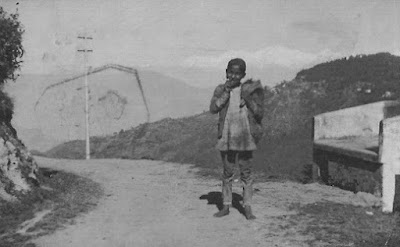
On the 30th March 1993 I walked around the hill at the high point of Darjeeling and stopped to look across at Kangchenjunga . On my return to England my father showed me a photograph he had taken from the same spot and sent to his parents on the 23rd February 1943. He had been on leave from his post in Calcutta (deploying radar), staying in a bungalow at Sing Tom, about half way down the hill from Darjeeling. " This is the first of my Darjeeling photographic efforts for you. The cigarette the boy is smoking was his "baksheesh." The highest snow-clad mountain is Kangchenjunga, the next highest after Everest. Propose following this up with one of my efforts per week ." The big picture showing Calcutta, Darjeeling and surrounds, and Imphal. View to the North over Darjeeling with Kangchenjunga the highest mountain and Gangtok in the far right distance. Places on the walk from Gangtok back to Sing Tom near Darjeeling are shown. Suspensio...
Horseshoe Crabs Past and Present: a NW Borneo Journey

Image
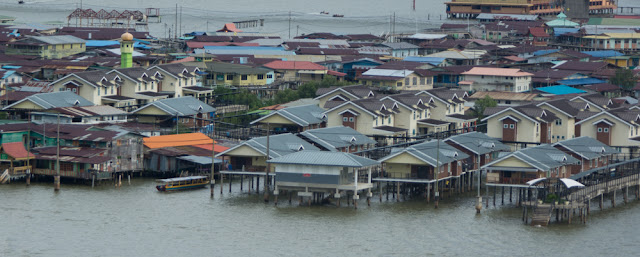
Horseshoe crabs figured strongly in my week. Last Saturday (April 1st 2017), I spoke with Kevin Laurie, a Hong Kong-based expert on horseshoe crab behaviour and conservation. He mentioned the existence of a wall decorated with horseshoe crabs in Kampung Ayer, the water village of Bandar, Brunei, in northwest Borneo. Armed with this tip, I visited Kampung Ayer on the evening of the following Thursday (April 6th), guided by two very knowledgeable locals, Wann and Mark Putera Delima. Kampung Ayer is an interesting place in itself, with Antonio Pigafetta describing the place as he found it when the surviving Victoria and Trinidad of Ferdinand Magellan's fleet visited in July 1521 (shortly after Magellan's death in the Philippines). His description of "Burne" was as follows: " that city is entirely built in salt water, except the houses of the king and certain chiefs. It contains twenty-five thousand hearths. The houses are all constructed of wood and built up fr...

The Hike to Guadalupe Peak

Image
Given a school half term and an urge to travel somewhere, James and I planned a hike up to Guadalupe Peak, the highest point in Texas at 2667 m. We flew to El Paso, picked up a rental car and drove east towards the Guadalupe Mountains. A short way past the border post (with its banks of cameras and guards with dogs) we saw a group of pronghorns (closest relatives, giraffes and okapis). After two hours of driving, there was El Capitan's spectacular form, towering above us as the road looped closer. El Capitan The track to Guadalupe Peak. Notice the switchbacks up that first wall of limestone. We stopped at the Pine Springs visitor center to take a look at the starting point for the trail and then turned off to drive along the road to Slaughter Canyon at dusk, often a good place for encountering wildlife. We came across a big group of mule deer and several jackrabbits with enormous ears. There were also red-tailed hawks and northern harriers, a kestrel, a ...

The Viking Mammen Style on a Rare British Brooch

Image
The Mammen style in the sequence of Viking art styles is very rarely encountered on artefacts found in the British Isles (Kershaw 2013). It has been documented on two brooches (held in the Ashmolean Museum, Oxford), one from West Stow Heath, Suffolk and the other from Bergh Apton, Norfolk (Hinton 1974, Kershaw 2013). The design on these brooches consists of a stylised bird with backward looking head from which a long head lappet extends, forming an interlace pattern with the bird's tail and wings. A leg with clawed foot is also depicted. The bird is designed to provide a compact fit into the square frame of the brooch. Kershaw (2013) notes that whereas the Mammen style of the bird is Scandinavian in origin, the square design of the brooch is broadly comparable with some rectangular fibulae found in northern Germany and the Netherlands. These are dated to the tenth century, which is consistent with the appearance of the Mammen style in Scandinavia. Two other specimens of this...

An Ancient Stave Church in the Fjords and an Archetype of Viking Age Art

Image
Perhaps the most iconic piece of Viking Age art is the carved decoration on the Urnes stave church , the main exemplar of the late Viking Urnes art style. Finding myself in Norway for work, I planned a weekend trip to Sogndal and surroundings, in the upper reaches of Sogneforden, with the Urnes church being the main objective. The celebrated late Viking Age Urnes style art of the Urnes stave church. A flight from Stavanger to Bergen and then another on to Sogndal (after some delays due to weather) delivered me to the area. Before coming in to land, I had a view in the winter dusk of Nærøyfjorden , famous UNESCO world heritage site. Seen in the Google earth image below, this area, at the very head of the mighty Sogneford, seems to have an epic setting. I was excited to see what this would look like from ground level. Sognefjorden with Lustrafjorden and the Urnes stave church in its upper reaches. Zooming in, this is the area in the upper reaches of Sogneforden...