Posts

Showing posts from 2025

Selby Abbey and the Coins of Henry I

Image
Visiting Selby Abbey earlier this year, I thought, this is very grand for a small town like Selby. My aunt Alexi quickly reminded me that, in fact, Henry I was born here and the place was once more important. The abbey was founded under William the Conqueror and celebrated its 950th anniversary in 2019. Notice the contrast between the early semicircular arches and doorway and the later Gothic pointed arches. Norman doorway with five orders of shafts with waterleaf capitals and striking chevron designs Selby Abbey was the first Norman Abbey in the North, founded by Royal Charter of William the conqueror and his wife Matilda around 1069. The Charter bestowed lands (Selby, Brayton, Snaith, Flaxley, Rawcliffe, and other places), privileges, and legal immunities (tax exemptions) upon the new foundation. It served to officially establish the Benedictine Abbey and grant it royal protection. Motivations for the grant are thought to have included the birth of William and Matilda's youngest...

Viking raids on France and Iberia in 844 and 845

Image
The mid-ninth century marked an important phase in Viking expansion across Western Europe. Large fleets penetrated deep inland via river systems, striking at both Christian and Islamic nations. The raids of 844 in the Iberian Peninsula and 845 in Francia are well attested in contemporary sources, and they reveal both the audacity of Viking maritime strategy and the differing responses of the kingdoms they attacked. A decade after the first recorded Viking attack on English soil in 789, the Vikings began a series of attacks on Francia, initially on the west coast and then in 1820 along the north coast, focussing on Aquitaine. In the 830s, internal conflicts weakened defences and the Vikings were quick to exploit the civil war. By 840 they had succeeded in penetrating the Rhine four times in order to sack the Frankish Empire's richest port at Dorestad. The  Annales Bertiniani  describe a raid on Gascony in 840 and later in the 840s a major raiding campaign began with several att...

From Sea Urchin Spines to Crystals: Adventures in early Mineral Identification

Image
The science of mineralogy progressed rapidly during the late 18th and early 19th centuries, but in earlier times, it wasn't always obvious if something was a fossil or a mineral. To illustrate the point, here's an interesting Victorian specimen from the Cumbrian mountain of Skiddaw, once in the collection of the colourful character Charles Ottley Groom-Napier (1839-1894) via the dealer Friedrich Krantz of Bonn. A Groom-Napier specimen of chiastolite from Skiddaw, his label referring to the invented Museum of Mantua and Montferrat (M&M) James Sowerby (1806) recognised the elongate features seen in this specimen as andalusite var chiastolite crystals ("MACLE or Chiastolite"), but noted that J. Woodward had earlier (1729) thought that these were the spines of sea urchins ("A black slate holding in it great numbers of spinulae of an Echinus spatagus "). " Mr. Davey having in the summer of 1804 found this substance on the summit of Mount Skiddaw...

An early specimen of ‘AMMONITES Walcotii’ and Sowerby’s ‘Mineral Conchology’

Image
A version of this article is published in Depositsmag . A fascinating aspect of palaeontology is the history of early descriptions and the process of assigning and revising the scientific names of fossils. A recently discovered nineteenth century ammonite specimen discussed here provides a vivid illustration of the sometimes tortuous process and can be connected with several illustrious naturalists and geologists from the seventeenth to nineteenth centuries. Geology in the first quarter of the nineteenth century The first quarter of the nineteenth century was a particularly important time in the evolution of geological thinking. In Britain, the first long stratigraphic sections were being published, the Geological Society was founded in 1807, the first nationwide geological map was published in 1815, and detailed investigations were underway across the country. A correspondent in the Philosophical Magazine (‘A Constant Reader’ 1815) promoted the work of James Sowerby and contempora...

Traditional Art of Gabon: Brass Adornments of the Fang

Image
" In a little bay we pass we see eight native women, Fans clearly, by their bright brown faces, and their loads of brass bracelets and armlets, intent on breaking up a stockaded fish-trap. "  Mary Kingsley, 1895, Travels in West Africa.  Mary Kingsley speculated that these eight ladies were wearing anklets, but couldn't see them since they were standing in the water. Living in Gabon in the 1990s, I bought one such bracelet (below), with beautiful incised decoration, from an elderly Fang lady who had with her a battered mask and an aged leather pouch containing this bracelet, an arrowhead-shaped piece of iron and a very simple thin brass bangle. A richly decorated copper alloy bracelet I purchased from an elderly Fang lady in Gabon in the 1990s (RS.AF2). A similar example is illustrated in Grébert (1932) reproduced in Grébert et al. (2003) ' Another brass ornament (see below) has a distinctive and symmetrical pattern of ornament, with a central rectangular field enclos...

The Viking Borre-style Gripping Beast Pendants

Image
A decade ago, I suggested that a 10th century gripping beast pendant found widely across the Viking world (Campbell 2013) may represent a bound shapeshifter (reminiscent of Loki's fate as recounted in the "Lokasenna" of the Poetic Edda), perhaps functioning as an amulet for the 'containment of chaos' . The design of the pendant features a highly contorted quadruped with forward facing head and a ribbon body connecting thorax with hindquarters in lateral view. Two of the animal's limbs are bound to an encircling rim and a third grips the creature's own ribbon body. The circling ring is ornamented with four fanged beast heads in facing pairs on each side of the pendant. Two small paws reach over the long ears of the lower two beast heads to grasp on to the encircling ring. Details of the ornament on the  fore- and hind-quarters vary between examples and a distinctive variant from the Lake Ilmen region of Russia lacks the beast heads around the rim of the pen...

The 'Ragnarok Stone' at Skipwith

Image
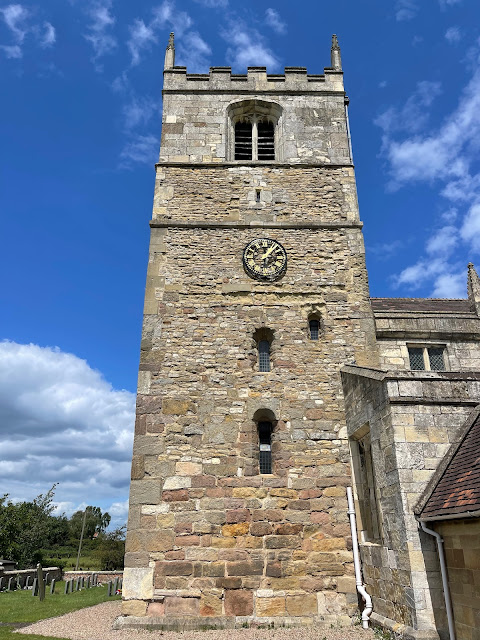
Skipwith (North Yorkshire) is the site of an ancient church containing a fascinating early medieval low relief sculpture. It lies immediately to the north of Skipworth Common, where tradition held that the few remaining Norse warriors from the failed 1066 invasion had gathered and buried their dead (at 'Danes' Graves'). St. Helen's Church has been renovated several times over the past millennium, but still preserves a pre-conquest structure in the form of the tower with its original Anglo-Saxon windows. The ancient tower of Saint Helen's Church at Skipwith, showing original Anglo-Saxon windows Set low inside the tower wall, in the modern vestiary, is an ancient image carved into a stone. It's thought to be a re-used Roman stone (magnesian limestone) with a pre-conquest carved scene, later included at the base of the church tower wall. The timing of the block's incorporation in the wall is unknown, the carving not having been noticed until 1866 following the ...